
Best Time to Aerate and Overseed in Oklahoma City: A Veteran’s Honest Guide
Short Answer: The best time to aerate Bermuda lawns in Oklahoma City is late spring through early summer (May through June), when the grass is actively growing and recovers quickly from the disturbance. Cool-season grasses (fescue, ryegrass) are best aerated and overseeded in early fall (September through early October), when soil temperatures are warm but air temperatures are starting to cool. Avoid aeration during summer drought, winter dormancy, or late fall when recovery is impossible. Overseeding is grass-type specific: cool-season grasses overseed with cool-season seed in fall; Bermuda does not overseed unless you are putting in winter ryegrass for off-season color. Here is the honest timing breakdown.
If you are looking up aeration and overseeding for an Oklahoma City area lawn, you are going to find a lot of conflicting advice. Some sources say spring. Some say fall. Some say both. Some say only if your lawn needs it, with no clear way to tell whether it does.
As a veteran-owned company that has worked on hundreds of properties across Oklahoma City, Norman, Edmond, Yukon, and Mustang, we want to give you a straight answer. The right timing depends on your grass type, the specific problem you are trying to solve, and the weather conditions for that year. Let us walk through it.
Aeration for Bermuda Lawns
Bermuda is the dominant warm-season grass across the Oklahoma City area, and it has specific timing for aeration. The window opens when the grass is fully out of dormancy and growing actively, typically late April or May, and runs through June. By July and August, the heat is too intense and the grass cannot recover quickly from the disturbance.
Late spring aeration on Bermuda gives you 2 to 3 months of active growing season for the lawn to fill in the holes and use the improved soil access. By mid-summer, you cannot tell the lawn was aerated, and root depth has improved dramatically.
September is a secondary window for Bermuda aeration if late spring was missed. The grass is still growing but slowing down for the season. Recovery is slower than in late spring but still good.
Aeration for Fescue and Cool-Season Lawns
Cool-season grasses (tall fescue, ryegrass, bluegrass) have the opposite timing. They go dormant or struggle in summer heat, and aeration in late spring would set them back during their hardest months. The right window is early fall (September through early October) when soil temperatures are still warm but air temperatures are dropping into the recovery range.
Fall aeration also pairs perfectly with fall overseeding, since the open holes provide excellent seed-to-soil contact for the new seed to germinate. This is the highest-value combination for cool-season lawns and is why most fescue lawns in our area get serviced in September.
Spring aeration on fescue is sometimes recommended but produces less benefit. The lawn has limited recovery time before summer stress, and overseeded grass is unlikely to survive its first summer with shallow roots.
When NOT to Aerate
Several timing windows are wrong regardless of grass type:
During summer heat (late June through August in our area). The lawn cannot recover and the holes can dry out and stress the surrounding grass.
During drought. Aeration on drought-stressed grass adds insult to injury. Wait until conditions improve.
Right after seeding or sodding. Established root systems need at least 6 months before aeration to avoid pulling out new growth.
During dormancy. Bermuda dormant from October through April should not be aerated. Fescue does not go fully dormant but cold weather (below 50 degrees consistently) limits recovery.
Why Aeration Matters in Oklahoma Soil
The Oklahoma City area sits on heavy clay soil that compacts easily and holds water unevenly. Compaction limits root depth, reduces oxygen at the root zone, and prevents fertilizer and water from reaching where they are needed. The result is shallow-rooted, weak-looking lawns that struggle in heat and drought.
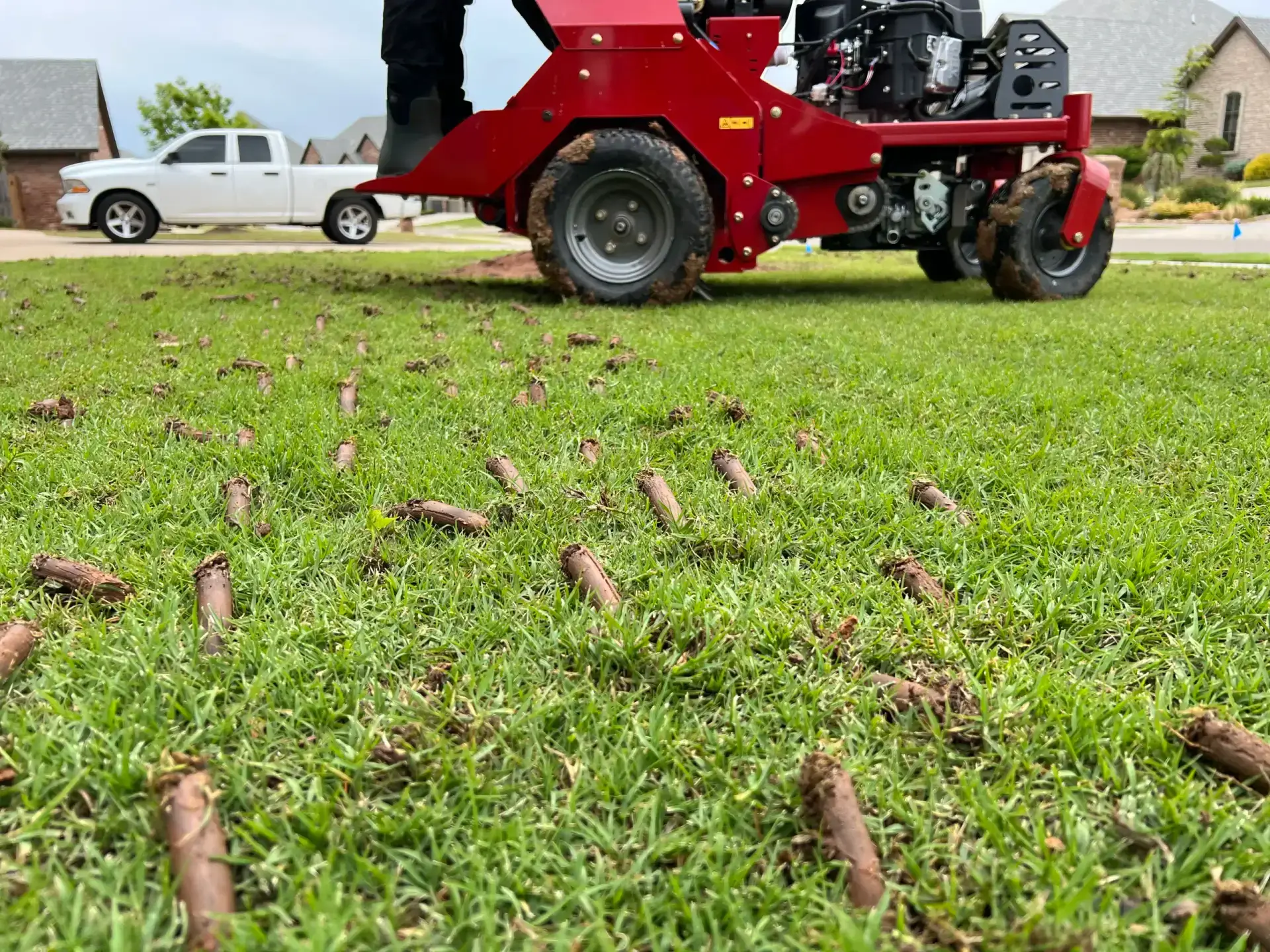
Aeration directly solves all of those problems. The plugs that come out break up the compacted layer. The holes that remain become channels for roots to grow down into. The soil structure begins to recover as the plugs break down and microbial activity returns.
For Oklahoma City Bermuda lawns, we typically recommend aeration once a year in late spring. Older or compacted properties may benefit from twice a year (late spring and fall). Newer construction lawns where heavy equipment compacted the soil during building benefit from annual aeration for the first 5 years.
Overseeding Timing
For cool-season lawns, overseeding pairs with fall aeration. The seed mix should match what is already growing (turf-type tall fescue blend for most properties). Apply seed at the recommended rate, water lightly multiple times daily for the first 2 weeks, then transition to deeper less frequent watering as the seedlings establish.
For Bermuda, overseeding is rarely needed because Bermuda spreads aggressively on its own. The exception is winter overseeding with perennial ryegrass to provide green color through the dormant Bermuda months. This is done in October on most properties.
What Aeration Cannot Fix
Aeration is one piece of a healthy lawn program, not a complete solution. It cannot fix:
Soil chemistry imbalances. If pH is off or major nutrients are missing, aeration helps fertilizer reach the roots but does not change the underlying chemistry. Soil testing and amendments are separate work.
Severe disease pressure. Active brown patch or take-all root rot needs fungicide treatment regardless of aeration.
Significant insect damage. Grubs, chinch bugs, or other pests need their own treatment.
Major drainage problems. Standing water and poor drainage need grading, French drains, or downspout extensions, not aeration alone.
What to Expect After Aeration
The lawn looks slightly disturbed for 2 to 3 weeks. Visible plugs sit on the surface and break down gradually. New green growth pushes through the holes within a few weeks as roots take advantage of the opened soil.
You can mow over the plugs after about a week. Do not rake them up; they are part of the recovery process. By 4 to 6 weeks, you cannot tell the lawn was aerated, but the underground benefits continue for the rest of the season.
What to Do Next
If you have a Bermuda lawn in the Oklahoma City area and you are thinking about aeration, May or June is the sweet spot. We are happy to come walk your property, look at compaction levels and overall lawn health, and recommend whether aeration this year is the right call. Sometimes the answer is yes, sometimes the answer is wait until next year. We will tell you straight either way. Reach out anytime.