Fertilization
Granular or Liquid Fall Fertilizer for Oklahoma City Lawns?
Elite Lawn Care • October 2026 • Oklahoma City, OK • 7 min read
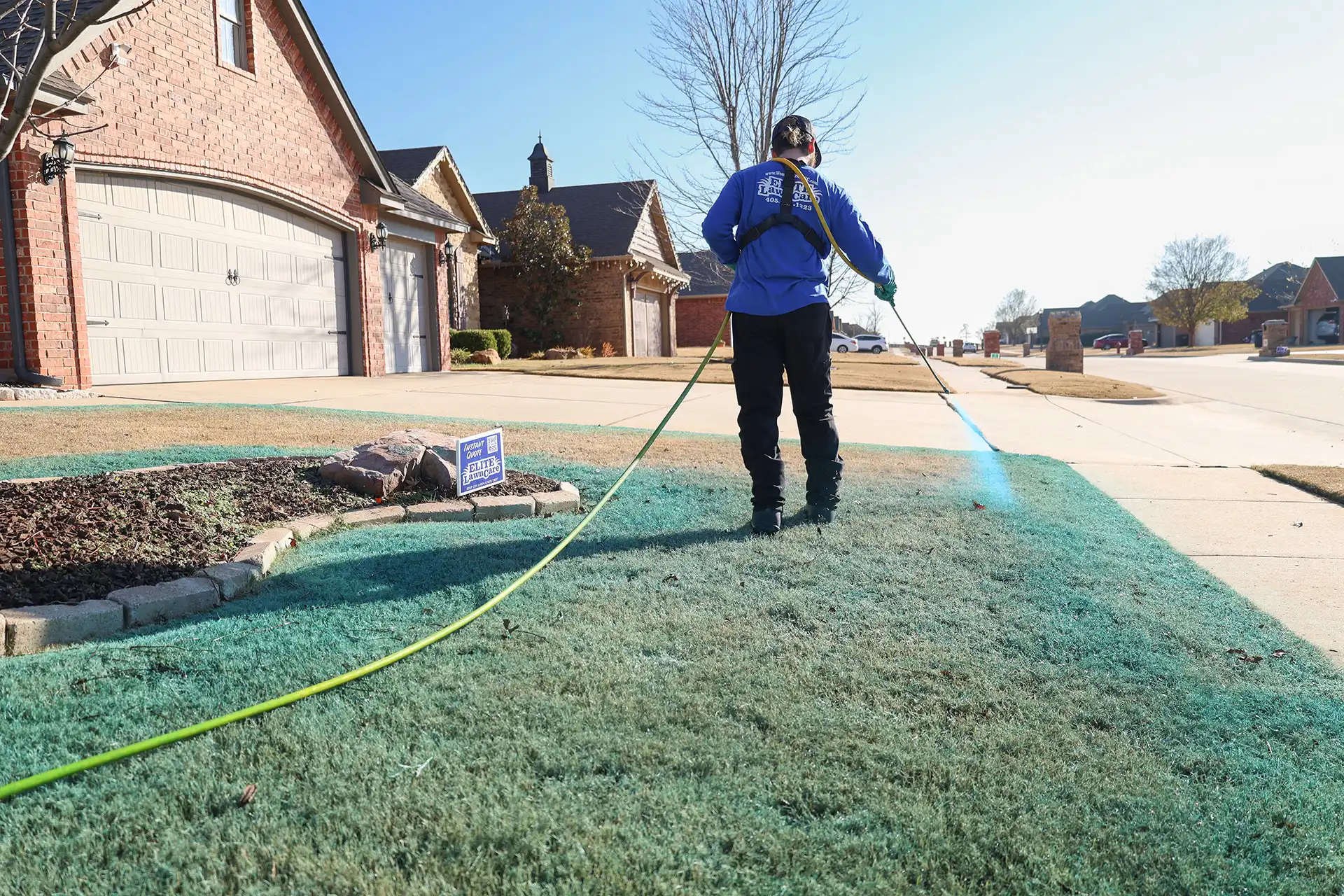
Short Answer: Neither is better across the board, and a company that insists otherwise is usually describing the equipment it already owns. Granular carries more nutrient per pass and delivers slow release nitrogen that feeds over six to eight weeks, which suits base feedings well. Liquid spreads more evenly, works faster, and is the better tool for iron and other corrections. Most strong programs use both. On Oklahoma lawns, whether you have Bermuda or fescue and whether the application is correctly timed matter far more than which form carried the nutrients.
If you have taken quotes from two lawn companies and one told you granular is the only serious option while the other said liquid is more advanced, you have run into one of the more frustrating parts of shopping for lawn care. Both claims are marketing rather than agronomy, and both usually describe whatever equipment is sitting in the truck.
These are two delivery methods with different strengths, and the right one depends on what a given application needs to do. Here is how each behaves and how Oklahoma conditions specifically change the comparison.
What Each One Is
Granular fertilizer is dry prills spread with a broadcast spreader. They sit on the soil surface until water dissolves them, which is why granular applications need to be watered in or timed ahead of rain. The nutrients then move down into the root zone with that water.
Liquid fertilizer is nutrients dissolved in water and sprayed across the turf. Part of it is absorbed directly through the leaf blade, which is called foliar uptake, and the rest reaches the soil and is taken up by roots. That second pathway is the main practical difference between the two.
Both deliver the same nutrients. Nitrogen is nitrogen whether it arrives as a prill or a droplet. What differs is how much goes down per pass, how quickly the plant receives it, and how long it keeps working.
Where Granular Has the Edge
Slow release nitrogen is the biggest advantage. Granular products can be coated or chemically formulated to break down gradually over six to eight weeks, feeding steadily rather than all at once. That is difficult to replicate in a liquid, where most nitrogen sources are immediately available.
For a base feeding on Bermuda through the growing season, that gradual release is exactly right. It supports steady growth rather than a spike followed by a fade, and it reduces the risk of burning turf during an Oklahoma summer when the lawn is already under heat stress.
Granular also carries more total nutrient per pass, which makes it efficient and means fewer visits to supply the same annual amount. And our clay based soils hold nutrients reasonably well once they reach the root zone, unlike sandy coastal soils where nitrogen leaches through quickly. What goes down here tends to stay available.
It is also far more practical for a homeowner applying it themselves. A spreader is inexpensive and simple to operate, while spraying liquid accurately across a lawn takes equipment and technique most people do not have.
Where Liquid Has the Edge
Coverage uniformity comes first. A spray pattern is more even than spread prills, which means no striping and no hot spots where a handful of granules landed together. On a lawn you judge by how it looks, that evenness shows within a couple of weeks.
Speed is the second advantage and it matters for corrective work. When a lawn needs something addressed rather than maintained, foliar uptake produces a response in days rather than weeks.
Iron is the clearest example. Where soil pH has climbed, iron becomes chemically less available to roots and the lawn goes pale even though nitrogen is adequate. Iron applied to the soil in those conditions largely locks up the same way. Sprayed on the leaf, it bypasses soil chemistry entirely and greens the lawn within about a week.
Liquid also carries several products efficiently in a single pass, and it suits treating turf and landscape beds on the same visit, which is part of why you see hose and backpack rigs on properties where more than the lawn is being serviced.
Oklahoma Conditions Worth Factoring In
Two local realities affect this comparison more than most homeowners expect.
The first is wind. We get plenty of it, and it matters for both methods in different ways. Granular prills are heavy enough to resist moderate wind, which is a genuine advantage on an open lot. Liquid spray drifts, so a windy day is a poor day to spray, and a good applicator will reschedule rather than push through it. If you spray your own lawn, early morning is usually your calmest window.
The second is watering in. Granular fertilizer does nothing sitting dry on the surface, so it needs moisture within a day or so, either from irrigation or from rain you timed it against. Our fall can go dry for stretches, and product sitting inert on the surface for a week is product you did not use. Liquid is already in solution, which removes that dependency and is a real point in its favor during a dry spell.
Our clay also compacts readily and drains slowly, so on a compacted lawn both methods lose some product to runoff. Aeration serves either approach better than choosing between them does.
What Strong Programs Actually Do
Across the properties we manage, the best results come from using both rather than picking a side. Granular carries the base feedings with slow release nitrogen working over weeks. Liquid handles iron, micronutrients, and anything that needs to act quickly.
Fall illustrates it well. On Bermuda and zoysia, the last nitrogen should have landed four to six weeks ahead of our early November frost, and granular with slow release suits that timing. After the nitrogen window closes, a liquid application carrying potassium or micronutrients can still go down without the cold damage and disease risk that nitrogen carries.
On a fescue lawn the late fall feeding in November is the exception where fast availability wins, because cold soil slows the microbes that slow release products depend on.
If a company offers only one method, ask why. It is not disqualifying and plenty of good work gets done with granular alone. It does mean the equipment may be steering the recommendation rather than your lawn.
The Comparison That Matters More
If we could redirect one question in this market, it would be away from method and toward grass type and timing.
Oklahoma City has both Bermuda and fescue lawns, frequently on the same block, and they need opposite fall schedules. Fescue wants a late feeding into November. Bermuda and zoysia need nitrogen stopped weeks before frost.
A perfectly chosen liquid applied to a Bermuda lawn in November will hurt it, producing tender growth heading into freezing weather and contributing to spring dead spot. The same application on fescue next door is the best thing you could do for it. The delivery method is a detail inside a decision that has already been made correctly or incorrectly at a higher level.
Rate is the other factor that outweighs method. An uncalibrated spreader running twenty percent heavy causes more trouble than any granular versus liquid difference could offset, and when homeowners tell us a product did not work, timing and calibration explain it far more often than the product does.
What to Do Next
Identify your grass before anything else. If your lawn stayed green last January it is fescue. If it turned tan it is Bermuda or zoysia and nitrogen should already be behind you for the year.
If you apply granular yourself, time it ahead of rain or plan to water it in, and calibrate the spreader once a season by running a measured area with a known weight and comparing what you used against the target rate on the bag. Fifteen minutes once a year closes most of the gap between do it yourself and professional results.
When comparing quotes, ask which method is used for which application and why, and whether the schedule changes depending on your grass. A company that can explain the reasoning rather than simply asserting one method is better is generally the one paying attention to your particular lawn.
If you would rather have someone match the method, product, and timing to your grass and soil, we are here for that. Elite Lawn Care is veteran owned and serves the Oklahoma City metro along with Siloam Springs, Arkansas. Call 405-735-1223 or visit weedcontrolokc.com for a free quote.