Pest Control
How to Seal Your Oklahoma City Home Against Winter Pests: A Room by Room Walkthrough
Elite Lawn Care • November 2026 • Oklahoma City, OK • 8 min read
Short Answer: Sealing your home against winter pests is the one part of this work you can do yourself, and it makes every treatment that follows more effective. Work the house in a loop: door thresholds and garage seals first because they account for the most traffic, then utility penetrations where pipes and vents pass through walls, then weep holes and foundation cracks, then soffit and attic vents, then interior moisture points under sinks and behind appliances. You are not trying to make the house airtight, which is impossible. You are removing the easiest routes so the population outside has to work harder. Here is the full walkthrough.
Most homeowners we walk properties with are surprised by how few of the openings are where they expected. People look for the dramatic gap, the hole in the siding, the obvious crack. The routes insects actually use are almost always boring, small, and in places nobody inspects because nothing has ever gone wrong there.
The good news is that exclusion is genuinely a do it yourself job. It takes an afternoon, the materials cost very little, and unlike most pest advice it produces a permanent result rather than one that wears off. It is also the single best thing you can do to make professional treatment work harder for you.
Here is how we would walk your house if we were doing it together, starting outside and finishing inside.
Start With Doors, Because That Is Where the Traffic Is
If you only do one thing on this list, do this one. Door thresholds account for more crawling insect entry than every other route combined on most of the homes we service.
Check every exterior door by closing it and looking for daylight along the bottom and sides from inside a darkened room. Any light you can see is a gap an insect can use, and a door sweep that has compressed or hardened by a quarter of an inch leaves a continuous opening across the entire width of the doorway. Replacement sweeps are inexpensive and install with a screwdriver.
Garage doors deserve extra attention because they are the worst offender in most homes. The rubber astragal along the bottom hardens, shrinks, and tears with age, and even a seal in good condition rarely closes completely at the two bottom corners where the panel meets the track. Those corners are a reliable entry point for crickets and spiders, and corner seal inserts are made specifically for this problem.
Work the Utility Penetrations
Every pipe, wire, and vent that passes through an exterior wall was drilled through that wall, and the gap around it was sealed with whatever the installer had on hand, if it was sealed at all.
Walk the perimeter and look specifically at the dryer vent, the hose bibs, the air conditioning line set where the refrigerant lines enter, the gas line, the electrical service entrance, and any cable or fiber penetration. Older caulk shrinks and cracks, and weather and settling open gaps that were fine at construction.
For gaps under about a quarter inch, exterior grade silicone or polyurethane caulk is the right material. For larger openings, use copper mesh or stainless steel wool packed into the void and then sealed over, rather than expanding foam alone. Foam by itself is easily chewed through and degrades in sunlight, though it works well as a backer behind mesh.
Check the dryer vent flap specifically. A flap that no longer closes fully is a wide open four inch doorway into your laundry room, and it is one of the most commonly overlooked entry points on a house.
Understand Weep Holes Before You Seal Anything
This is where well meaning homeowners cause problems, so it is worth being precise.
If your home has brick veneer, the small vertical gaps in the mortar along the bottom course are weep holes. They are supposed to be there. They allow moisture that gets behind the brick to drain out and let the wall cavity breathe. Sealing them with caulk traps water in the wall and creates a far more expensive problem than any insect will.
The correct approach is to screen rather than seal. Stainless steel weep hole covers or bronze wool inserts allow drainage and airflow while blocking insect entry. They cost very little, install by hand without tools, and solve the problem without compromising the wall.
While you are at that level, inspect the foundation itself for cracks at the slab perimeter and where the slab meets the wall. Hairline cracks are normal in Oklahoma soil and can be sealed with a masonry caulk. Anything wider than a pencil is worth having looked at for reasons beyond pest control.
Look Up at Soffits, Vents, and Eaves
The upper portion of the house gets almost no homeowner attention and accounts for more entry than most people would guess, particularly for spiders and flying insects that later become crawling problems inside.
Check soffit vents and gable vents for torn or missing screening. Look at the junction where the soffit meets the wall, which often opens up as materials age and settle. Inspect attic vents and any roof penetration for gaps in the flashing or collar.
This is also where webbing accumulates, and webbing is a useful diagnostic. Heavy web buildup in the eaves and around exterior light fixtures tells you there is a reliable food supply up there, which means flying insects are congregating at that level. Knocking down webbing and treating the eaves removes both the spiders and the harborage that keeps drawing them back.
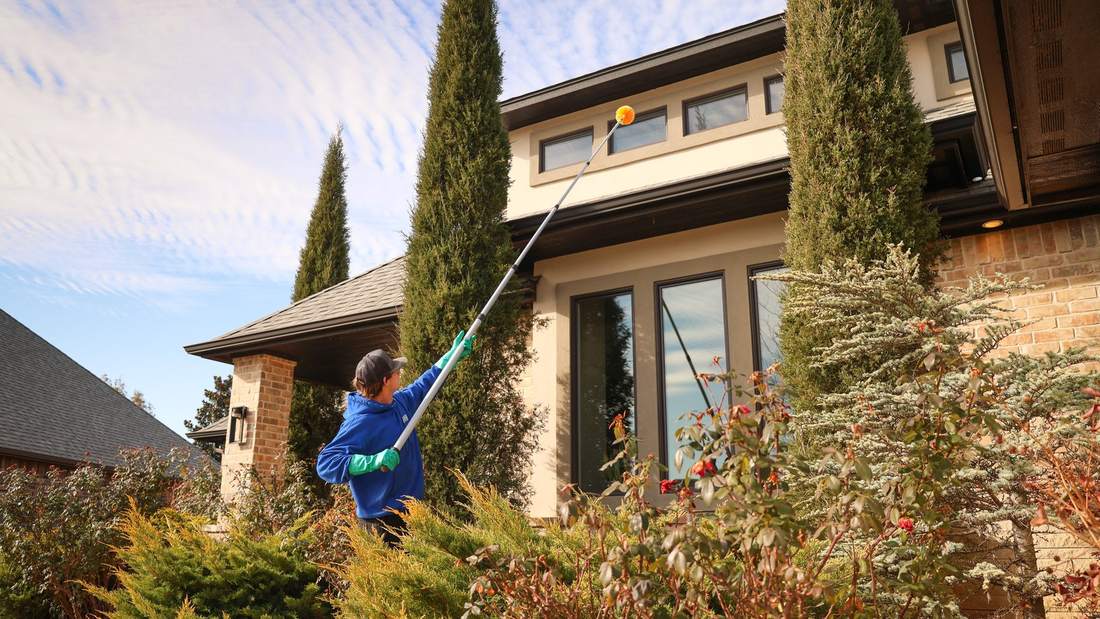
If the work is above comfortable ladder height, this is a reasonable thing to hand off. Our technicians treat soffits and eaves with extension equipment as part of the exterior work, and nobody needs to end a November Saturday on a ladder.
Pull the Landscape Back From the Wall
Exclusion is not only about sealing. A great deal of it is simply removing the conditions that stage insects against your foundation in the first place.
Pull mulch, leaf litter, and dense ground cover back to leave a dry band of several inches of bare soil or gravel against the wall. Millipedes, pillbugs, earwigs, and crickets live in exactly that damp organic layer, and moving it back moves their staging area away from your entry points.
Trim shrubs and foundation plantings so nothing touches the siding or brick. Branches and dense growth against the wall create a humid, shaded corridor that insects travel and that keeps the wall itself damp. Move firewood away from the house and keep it off the ground, because a stack against the foundation is both harborage and a bridge.
Finally, fix the water. A downspout discharging at the foundation, an irrigation head spraying the wall, or a low spot that holds water after rain will undo a lot of otherwise good work. Crawling insects follow moisture more reliably than they follow anything else.
Finish Inside at the Moisture Points
Interior exclusion is less about entry from outside and more about removing the conditions that let a few insects become an established population.
Look under every sink at the escutcheon plates where supply lines and drains pass through the cabinet back or floor. These gaps connect directly into wall and floor cavities and are frequently wide open. Seal them with caulk or fit an escutcheon that actually closes. Do the same behind the dishwasher, the refrigerator water line, and the washing machine box.
Check the gap where the bathtub or shower surround meets the wall and floor, and any access panel behind a tub. Repair drips and address condensation on cold water lines. The bathrooms and laundry room are where we most often find millipedes and pillbugs precisely because those rooms offer the moisture the rest of the house does not.
Reduce clutter in garages, utility rooms, and storage closets. Cardboard stored on a garage floor is both shelter and food for several of the insects on this list, and plastic totes solve that for very little money.
What Sealing Will and Will Not Do
We want to be straight with you about the limits, because overselling exclusion sets people up for disappointment.
Sealing a house well will meaningfully reduce what gets in, and it makes every treatment that follows more effective because fewer insects are bypassing the treated surfaces. It is genuinely worth the afternoon.
What it will not do is make the house airtight. No house is. There will always be routes you cannot find or cannot close without creating a moisture problem, and the population living in your landscape will keep testing them every time the temperature drops. Exclusion narrows the front. It does not end the fight.
That is why the two approaches belong together. You close the easy routes, and treatment handles the population that is still arriving at the ones you could not close.
What to Do Next
Walk your house this weekend with a screwdriver, a tube of exterior caulk, a package of weep hole covers, and a replacement door sweep. Those four items cover most of what we have described and will cost less than a tank of gas.
When you are finished, you will have a clear picture of where your house is actually vulnerable, which makes the conversation with any pest control company far more productive. If you would rather have someone handle the parts that involve ladders, or you want the perimeter and interior treated so the openings you could not close stop mattering, we are glad to help.
We are a veteran owned company serving Oklahoma City and the surrounding metro, including Edmond, Norman, Moore, Yukon, Mustang, Midwest City, Del City, Bethany, Choctaw, Piedmont, The Village, Harrah, Newcastle, Blanchard, and Tuttle. Call (405) 735-1223 or request a quote at weedcontrolokc.com.